FDA Requirements for Importing Spices into the United States: What You Need to Know About FSVP, Import Alerts, and Prior Notice
Introduction
Your container has arrived at the port after waiting for weeks. But instead of a delivery confirmation, you receive a notice “your shipment has been detained for FDA inspection”. The cost of storage is mounting, your customers are waiting and you are left wondering: “what went wrong?”. Below are the FDA requirements for importing spices you should consider.
FDA spice import requirements come from three different directions; the Foreign Supplier Verification Program (FSVP), FDA’s Import Alert system, and Prior Notice filing deadlines. None of these are complicated on their own. What trips up most procurement teams is that the right documentation has to exist before shipment, and not after a customs officer asks for it.
Why Compliance Matters for Spice Importers
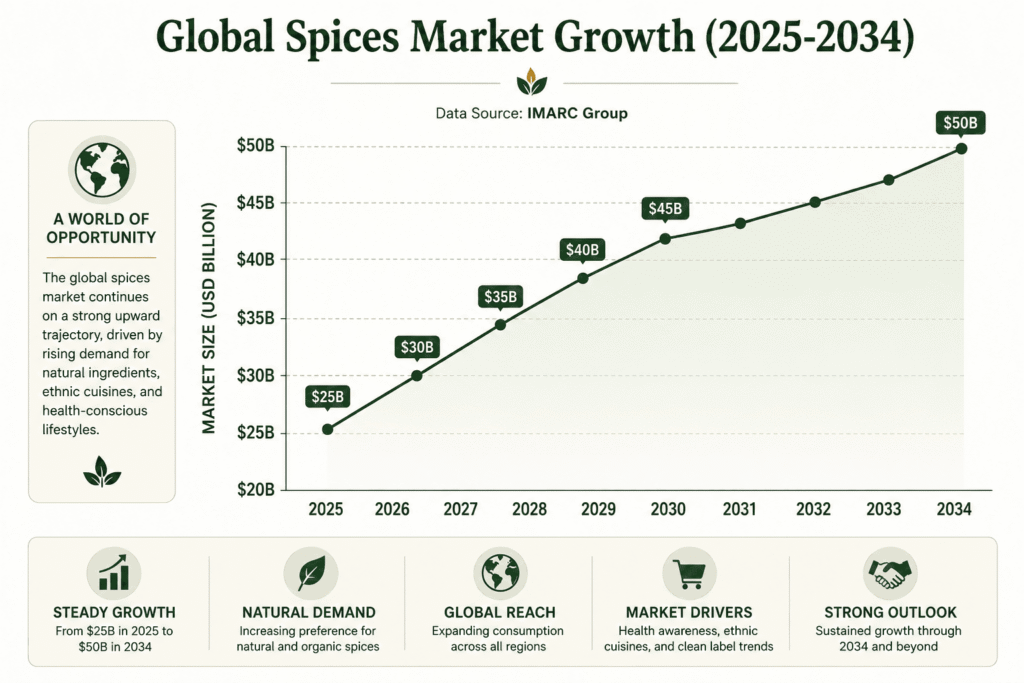
The U.S. spices market is part of a global industry valued at USD 27.51 billion in 2025, projected to reach USD 43.60 billion by 2034 (Research And Markets). The United States is one of the largest and most valuable export destinations for spices worldwide.
But with opportunity comes regulation. The FDA enforces strict safety and labeling standards for all food products entering the U.S., including spices, of which non-compliance can result in:
- Shipment detention at the port of entry
- Mandatory recalls of products already in the market
- Civil and criminal penalties for repeated violations
- Import Alerts that flag your supplier for automatic detention of future shipments
- Loss of buyer trust and business opportunities
The good news? This guide walks through what FSVP actually requires, what each relevant Import Alert covers, how Prior Notice timing works, and exactly what we build into every Jaaf Harvest shipment so that documentation is already in hand when you need it.
Table of Contents
- Introduction
- FDA Classification of Spices
- Food Facility Registration: The Foundation of Compliance
- FSVP Explained: Who’s Responsible, What You Need, How We Help
- Import Alert 99-19: Salmonella in Spices — What Triggers It and How We Test Against It
- Import Alert 99-42: Heavy Metals — Lead, Arsenic, and Cadmium in Spices
- Import Alert 99-41: FSVP Violations — Why This One Targets Importers, Not Suppliers
- Prior Notice: Filing Requirements and Deadlines
- What Documentation You Need From Your Foreign Supplier
- How Jaaf Harvest Provides FSVP-Ready Documentation
- FSMA Traceability Rule (FTL) – What Changed January 2026
- FAQ: FDA Requirements for Importing Spices
FDA Classification of Spices
Spices are classified as food products under the Federal Food, Drug, and Cosmetic Act (FFDCA). Within this framework, spices fall into two main categories:
|
Category |
Examples |
Compliance Implications |
|
Whole Spices |
Dried ginger, Cinnamon sticks, whole peppercorns, cloves, dried turmeric |
Generally lower risk for microbial contamination; higher risk for physical contaminants (stones, foreign matter) |
|
Ground Spices |
Ginger powder, turmeric powder, ground cumin, paprika, , |
Higher risk for microbial contamination (Salmonella) and adulteration; requires more rigorous testing |
Understanding this classification matters because ground spices typically require more frequent testing and stricter process controls due to their higher surface area and processing complexity.
Food Facility Registration: The Foundation of Compliance
Under the Bioterrorism Act of 2002 and later amended by the FSMA, all domestic and foreign facilities that manufacture, process, pack, or hold food for consumption in the United States must register with the FDA.
Who Must Register?
- Foreign facilities that export food to the U.S. (including spice processors, packers, and warehouses)
- Domestic facilities that manufacture, process, pack, or hold food for U.S. consumption
- Exemptions: Farms (under certain conditions), retail food establishments, and restaurants
Key Requirements
|
Requirement |
Detail |
|
Registration Cycle |
Renew every even-numbered year (2026, 2028, 2030, etc.) |
|
US Agent |
Foreign facilities must designate a US Agent who resides in the U.S. and is available during business hours |
|
Update Requirement |
Must update registration within 60 days of any significant change (ownership, products, US Agent) |
|
Registration Fee |
Free – no cost to register |
|
Registration Number |
Unique number must appear on all shipping documents and customs entries |
Consequence of Non-Compliance: The FDA can suspend your registration, and products from unregistered facilities will be refused entry at the border.
FSVP Explained: Who’s Responsible, What You Need, How We Help
The Foreign Supplier Verification Program is the regulatory backbone of food import compliance under the FDA Food Safety Modernization Act. In plain terms, FSVP for importers means every U.S. importer of record has to verify and document that their foreign suppliers are producing food under the same safety standards FDA requires domestically.
That responsibility sits with the importer. A complete FSVP file generally includes a hazard analysis for each product, evidence of the supplier’s food safety controls, records of verification activity (testing, audits, or documentation review), and a written assurance of compliance from the supplier.
We provide all four as standard with every Jaaf Harvest shipment not as a special request, but built into how we ship. If you’ve worked with suppliers before who could only produce some of this on request, that gap is exactly what we set out to close.
What FSVP Requires of Importers
|
Requirement |
What It Means |
|
Hazard Analysis |
Identify known or reasonably foreseeable hazards for each product (biological, chemical, physical) |
|
Supplier Verification |
Verify that the foreign supplier is producing food safely – through audits, testing, or other means |
|
Corrective Actions |
Have a plan for when food does not meet safety standards |
|
Records |
Maintain all documentation for at least 2 years |
What Importers Need from Their Suppliers
|
Documentation |
Purpose |
|
Certificate of Analysis (COA) |
Proves the product has been tested for safety and quality |
|
Hazard Analysis Summary |
Shows the supplier has identified and controlled hazards |
|
Supplier Verification Records |
Evidence of supplier audits or testing |
|
Written Assurance |
For very small importers, a letter from the supplier confirming compliance |
FSVP Exemption for Very Small Importers
If your average annual sales of human food are less than $1 million (adjusted for inflation), you may qualify for modified FSVP requirements. You must still:
- Document that you qualify as “very small”
- Obtain written assurance from your foreign supplier every 2 years
- Maintain records of your qualification
How Jaaf Harvest Helps: We provide all FSVP-ready documentation including hazard analysis summaries, COAs, and written assurance letters for very small importers. Visit our compliance page to access these documents.
Import Alert 99-19: Salmonella in Spices — What Triggers It and How We Test Against It
Import Alert 99-19 is FDA’s detention list for products that appear to be Salmonella-adulterated, and spices make up a large share of what is on it. FDA’s risk profile work has found Salmonella prevalence in imported spice shipments in the range of roughly 6–7%, higher than most other regulated imported foods.
The defense against this is not paperwork after the fact. It is testing and a validated kill step (like steam or heat treatment) before a shipment ever leaves origin. That is the standard we hold our own sourcing to, and it is documented in the hazard analysis we provide with every order, so your team can see the Salmonella control measures in writing rather than taking our word for it.
Import Alert 99-42: Heavy Metals — Lead, Arsenic, and Cadmium in Spices
Import Alert 99-42 covers foods containing toxic elements including arsenic, lead, cadmium, and mercury, and it is a category FDA has prioritized under its “Closer to Zero” initiative, particularly for products that reach infants and children. Turmeric is one of the most commonly flagged spices for lead, since the plant readily absorbs it from contaminated soil and processing equipment, though enforcement is not limited to turmeric or to this one alert.
Because heavy metal contamination varies by lot and processing conditions rather than just by country of origin, we test at the lot level and include those results in your documentation, so “where it is grown” is not the only thing you should be relying on.
Import Alert 99-41: FSVP Violations — Why This One Targets Importers, Not Suppliers
Most Import Alerts target foreign manufacturers. Import Alert 99-41 is different: it targets the importer’s FSVP compliance directly. If FDA inspects your company and finds your FSVP program is missing or inadequate, your name goes on the Red List, and future shipments of that food can be detained regardless of which supplier they come from.
This is the one place where having a reliable supplier doesn’t fully protect you. Your own FSVP file has to be complete, too. Part of why we build FSVP documentation into every shipment is so that piece of your compliance picture is already taken care of.
Prior Notice: Filing Requirements and Deadlines
Prior Notice is separate from FSVP, it is a timing requirement. FDA has to electronically receive and confirm your Prior Notice submission before your shipment arrives at the U.S. port of entry, and the deadline depends on transportation mode:
|
Mode of Transport |
Minimum Advance Notice |
|
Road |
2 hours before arrival |
|
Rail |
4 hours before arrival |
|
Air |
4 hours before arrival |
|
Vessel (ocean) |
8 hours before arrival |
|
International mail |
Before the shipment is sent |
Prior Notice can be filed up to 15 days in advance through FDA’s Prior Notice System Interface (PNSI), or up to 30 days in advance through a customs broker’s ABI/ACE system, which is how most commercial shipments handle it. It also needs to match your CBP entry exactly, same port, arrival date, importer of record, and product description. We coordinate with with our trusted shipping companies on these details ahead of arrival rather than leaving it to be sorted out at the last minute.
What Documentation You Need From Your Foreign Supplier
Pulling the above together, here’s what a complete supplier documentation file should include:
- FSVP summary covering hazard analysis and verification activities
- Written assurance from the supplier confirming compliance with U.S. food safety requirements
- Pathogen testing records (Salmonella, relevant to Import Alert 99-19)
- Heavy metal testing records (arsenic, lead, cadmium, mercury, relevant to Import Alert 99-42)
- Facility registration information for the manufacturer, required for Prior Notice filings
- Country-of-origin and shipment data matching your CBP entry
If you’re sourcing from a supplier who can’t produce these on request, it’s worth asking why, and worth comparing against what you get from us by default.
How Jaaf Harvest Provides FSVP-Ready Documentation
We started this business knowing that the easiest way to earn trust with a U.S. importer is not to talk about compliance but to hand over the documentation before anyone has to ask. Every shipment includes an FSVP summary, hazard analysis, and written assurance as standard. Testing records and facility information live in our compliance page, so your team has one place to pull what is needed for an FSVP file, an FDA inspection, or a broker’s Prior Notice filing.
FSMA Traceability Rule (FTL) – What Changed January 2026
The FDA Food Safety Modernization Act (FSMA) Rule 204 states that the Food Traceability List (FTL) took effect January 20, 2026.
What the Rule Requires
|
Requirement |
Detail |
|
Affected Products |
Herbs and spices on the FTL are explicitly covered |
|
Record keeping |
Manufacturers, processors, and packers must maintain records of Key Data Elements (KDEs) for Critical Tracking Events (CTEs) |
|
Traceability Lot Codes |
Each lot must be assigned a unique code that links to production and distribution records |
What This Means for Importers
- You must be able to trace each shipment back to its origin (specific farm or supplier)
- You must maintain records linking your shipment to your supplier’s lot codes
- The FDA can request these records within 24 hours during an investigation
Consequences of Non-Compliance
- Product seizures
- Mandatory recalls
- Civil and criminal penalties
How Jaaf Harvest Helps: Every shipment includes lot traceability records. We maintain harvest dates, processing dates, and lot codes for every batch.
Good Manufacturing Practices (CGMP) – For Suppliers
While importers are responsible for FSVP compliance, suppliers are responsible for implementing Current Good Manufacturing Practices (CGMP) under 21 CFR Part 117.
Key CGMP Requirements for Spice Processors
|
Area |
Requirement |
|
Facility Maintenance |
Sanitary conditions, proper ventilation, pest control |
|
Employee Training |
Food safety and hygiene practices to prevent cross-contamination |
|
Quality Control |
Regular testing for microbial and chemical contaminants |
|
Documentation |
Records of all testing and corrective actions |
As an importer, you should verify that your supplier follows CGMPs typically through audits or third-party certifications.
Labeling Requirements for Imported Spices
All spice products imported into the U.S. must comply with FDA labeling regulations under 21 CFR Part 101.
What Must Be on the Label
|
Element |
Requirement |
|
Statement of Identity |
Common name of the product (e.g., “Ground Ginger”) |
|
Net Weight |
Quantity in both avoirdupois and metric (e.g., “16 oz (453 g)”) |
|
Ingredient List |
All ingredients in descending order by weight |
|
Allergen Information |
Any known allergens (e.g., “Contains: Mustard”) |
|
Manufacturer Information |
Name and address of manufacturer, packer, or distributor |
|
Nutrition Facts |
Required if making health claims; otherwise optional for single-ingredient spices |
|
Country of Origin |
“Product of Nigeria” (required for all imported products) |
|
Organic Certification |
USDA Organic seal only if certified (use of seal without certification is illegal) |
Retail-Ready Packaging – What to Look For
|
Feature |
Why It Matters |
|
FDA-compliant label |
No regulatory issues at retail |
|
Barcode (UPC) |
Faster checkout, accurate inventory |
|
Resealable pouch |
Keeps spices fresh, reduces waste |
How Jaaf Harvest Helps: Our retail-ready packaging includes full FDA-compliant labels, barcodes, and resealable stand-up pouches – ready to go on your shelf.
Import Certification: New Requirements (Starting October 2025)
On October 31, 2025, the FDA implemented new import certification requirements for certain spices from specific regions – the first time the FDA exercised this congressional authority under Section 801(q) of the FD&C Act.
What This Means
- Some spice shipments from designated regions must be accompanied by a certificate from a qualified certifying entity
- Certifying entities include:
- Government agencies of the exporting country
- FDA-accredited third-party certification bodies
- Certificates can include:
- Shipment-specific certificates
- Certified facility lists
- Test records
- Audit reports
Your Responsibility as an Importer
- Check whether your supplier is in a region requiring import certification
- Ensure the supplier obtains the required certification before shipping
- Factor certification timelines into your ordering schedule
How Jaaf Harvest Helps: We monitor regulatory changes and provide all required documentation. Our compliance page is updated with current compliance status.
Jaaf Harvest Provides FSVP-Ready Documentation
We built our business around transparency and compliance. Here is what we provide to every customer.
|
Document |
Purpose |
How to Access |
|
Certificate of Analysis (COA) |
Test results for moisture, heavy metals, and microbial contaminants |
Included with every shipment; samples on Trust Center |
|
Hazard Analysis Summary |
Identified hazards and controls for ginger, turmeric, and hibiscus |
Download from Trust Center |
|
FSVP Summary |
Supplier verification activities and compliance status |
Download from Trust Center |
|
Written Assurance |
For very small importers – confirms we meet FDA safety standards |
Download from Trust Center |
|
Lot Traceability Records |
Harvest dates, processing dates, lot codes |
Provided with every shipment |
|
FDA Facility Registration |
FEI number and registration status |
Displayed on Trust Center |
FAQ: FDA Requirements for Importing Spices
1. Is FDA certification mandatory for all spices imported to the US?
FDA food facility registration is mandatory. Import certification is currently required for certain spices from specific regions (as of October 2025). All importers must comply with FSVP and, by January 2026, FTL traceability requirements.
2. What is FSVP and why does it matter to me?
FSVP (Foreign Supplier Verification Program) requires importers to verify that foreign suppliers meet FDA safety standards. Importers are legally responsible for maintaining FSVP records.
3. How much does FDA registration cost?
FDA facility registration is free. Associated costs include US Agent services, compliance consulting, and third-party audits.
4. How long does FDA registration take?
Online registration takes 1-2 hours if you have all required information. FDA issues the registration number immediately. However, building a comprehensive compliance system (HACCP, traceability) typically takes 3-6 months.
5. What is a Certificate of Analysis (COA)?
A COA is a document summarizing test results for a specific batch of product. It proves the product meets specifications including moisture, heavy metals, and microbial safety.
6. What happens if my shipment is detained by FDA?
With DDP shipping, the supplier manages customs clearance including any exams or detentions. Without DDP, the importer bears all risk. We strongly recommend DDP for first-time buyers.
7. Do I need a customs bond?
With DDP shipping, no. The supplier provides the bond. With FOB or CIF, you must post a customs bond.
8. What is an FDA Import Alert?
An Import Alert authorizes automatic detention of shipments from flagged suppliers. Import Alert 99-19 (Salmonella), 99-41 (FSVP), and 99-42 (Heavy Metals) are most relevant for spices.
9. What are the FTL traceability requirements?
FSMA Rule 204 requires lot-level recordkeeping for herbs and spices on the Food Traceability List, effective January 20, 2026. You must be able to trace each shipment back to its origin.
10. Can I import spices if I am a very small importer?
Yes. You may qualify for modified FSVP requirements, but you must still document your qualification and obtain written assurance from your supplier every 2 years.
11. What is DDP shipping and how does it help with FDA compliance?
DDP (Delivered Duty Paid) means the supplier handles customs clearance, duties, and final delivery. With DDP, the supplier manages FDA compliance – including filing Prior Notice and managing any exams. One price. Your door. No surprises.
12. How do I verify if a supplier is FDA-compliant?
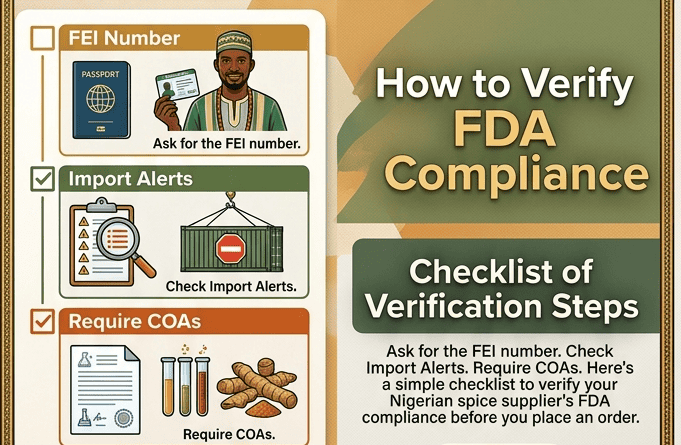
Ask for the FEI number. Check Import Alerts. Require COAs. Verify FSVP documentation. Visit their Trust Center. We provide all of this publicly.
Compliance Is Your Competitive Advantage
The U.S. spices market is growing, and so is regulatory complexity. But here is the opportunity:
- Compliance creates competitive barriers. Suppliers who invest in compliance have a structural advantage over those who cut corners.
- Documentation builds trust. Buyers are more likely to work with suppliers who provide FSVP-ready documentation.
- Traceability protects your brand. If a recall occurs, you can act quickly and protect your reputation.