The Complete U.S. Importer’s Guide to Sourcing Nigerian Ginger, Turmeric & Hibiscus: Quality, Compliance, and Logistics
Introduction
You have been waiting for a shipment for weeks. It finally arrives. When you open the bags, the color is wrong, the aroma is weak, and when you ask the supplier for a Certificate of Analysis, they say, “We don’t do that”.
That is not a gamble you should to take.
Sourcing spices from Nigeria offers incredible opportunities such as competitive pricing, distinct flavor profiles, and reliable supply. But without the right partner, it also carries risks; inconsistent quality, missing documentation, and customs headaches.
This guide walks you through everything U.S. buyers need to know about importing Nigerian ginger, turmeric, and hibiscus. From quality testing to FDA compliance to DDP shipping, consider this your roadmap.
And if you are tired of gambling on suppliers, Jaaf Harvest is here to remove the risk.
Table of Contents
- Introduction
- Why Nigerian Spices? The Origin Advantage
- The Three Core Products: Brief Overview
- Nigeria vs. Other Origins: Where Does Nigeria Stand?
- Quality Metrics That Matter
- FDA Compliance for Spice Importers
- Red Flags When Evaluating a Nigerian Spice Supplier
- How to Evaluate a Nigerian Spice Supplier (Checklist)
- Getting Started with Jaaf Harvest
- FAQ: Sourcing Nigerian Spices for the US Market
Why Nigerian Spices? The Origin Advantage
Nigeria is one of West Africa’s most productive agricultural nations. The country’s warm climate, fertile soil, and extended growing seasons create ideal conditions for spice cultivation.
Here is what makes Nigerian spices distinctive;
Nigerian Ginger
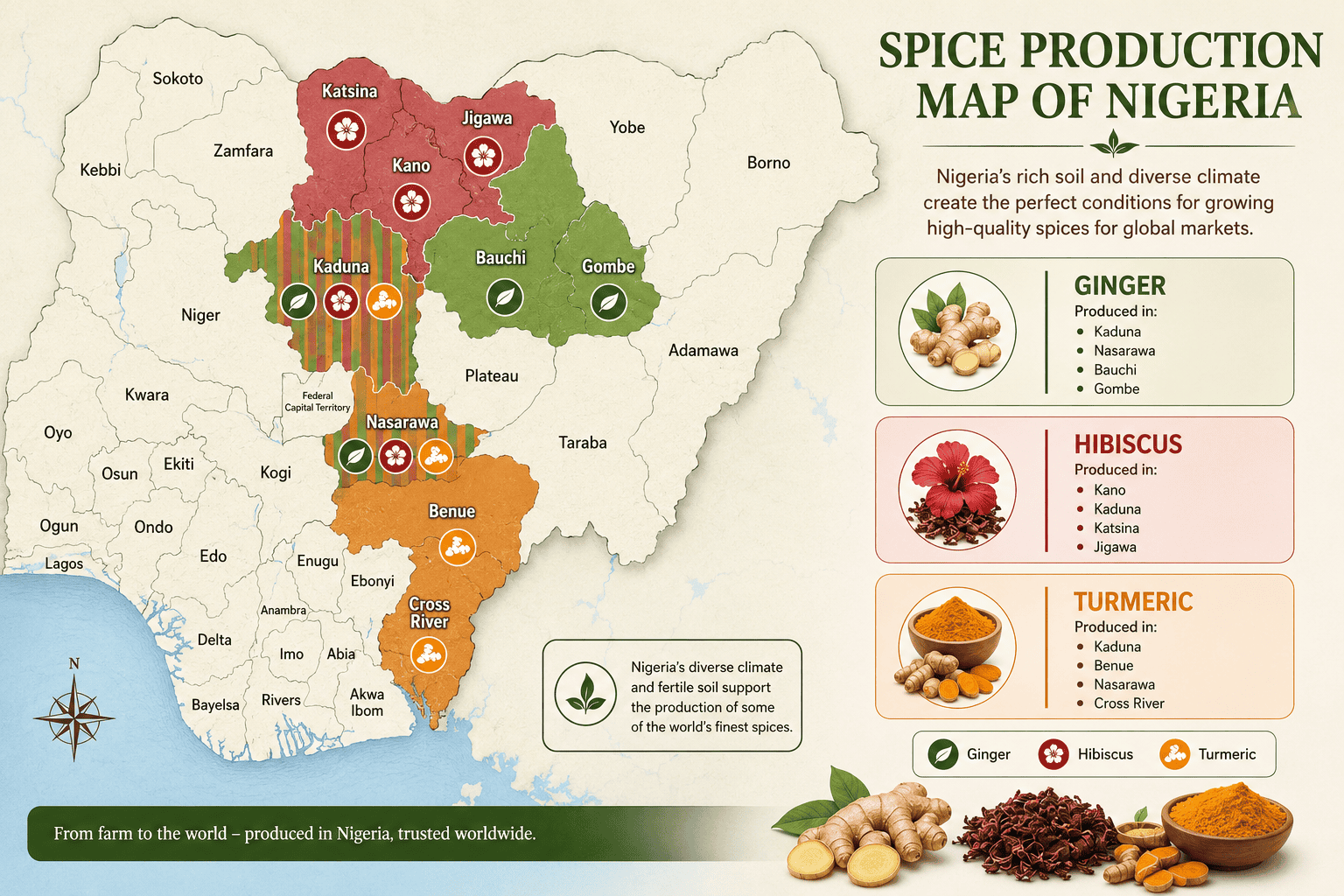
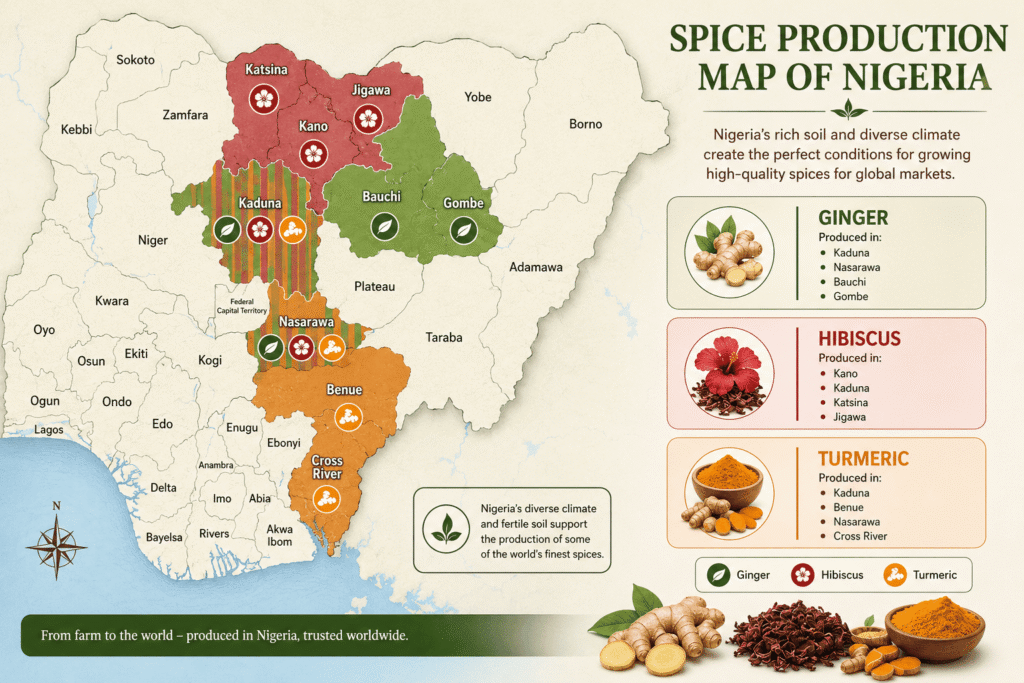
Grown primarily in Kaduna, Nasarawa, Bauchi and Benue states, Nigerian ginger is prized for its high oleoresin content, the compound that delivers heat and flavor. The pungency level often exceeds that of ginger from other origins, making it a favorite for tea blenders, spice mix manufacturers, and nutraceutical companies.
Nigerian Turmeric
Nigerian turmeric offers curcumin content ranging from 2.5% to 5.5% which is comparable to Indian turmeric but typically at a lower price point. The deep orange-yellow color comes from high curcumin levels, which also drive the health benefits consumers seek.
Nigerian Hibiscus (Zobo Leaves)
Hibiscus sabdariffa, known locally as zobo, flourishes in Nigeria’s tropical climate. The dried calyces produce a deep crimson tea with tart, cranberry-like notes. Nigeria is a top three global hibiscus supplier, with pricing significantly more competitive than India or Egypt.
Harvest seasons at a glance
|
Crop |
Primary Harvest |
Secondary Harvest |
|
Ginger |
November – February |
August – September |
|
Turmeric |
December – March |
– |
|
Hibiscus |
November – January |
April – May |
The Three Core Products: Brief Overview
Each of these products deserves its own deep dive (and we have separate guides for that). Here is a quick reference to get you started.
|
Product |
Key Quality Metric |
Typical US Applications |
|
Dry Split Ginger |
Volatile oil ≥1.5% |
Tea blends, spice mixes, nutraceuticals, ginger ale |
|
Dry Split Turmeric |
Curcumin ≥3.0%, Lead <0.5 ppm |
Golden milk, curry powders, supplements, natural coloring |
|
Dried Hibiscus Flower |
Color value ≥200 units |
Herbal teas, ready-to-drink beverages, zobo drink |
For detailed specifications, download our Nigerian Spice Sourcing Checklist at the end of this guide.
Nigeria vs. Other Origins: Where Does Nigeria Stand?
Every origin has strengths and weaknesses. Here is how Nigeria compares to India and Egypt – the two largest competitors for ginger, turmeric, and hibiscus in the U.S. market.
|
Factor |
Nigeria |
India |
Egypt |
|
Primary spice products |
Ginger, turmeric, hibiscus |
Ginger, turmeric, chili, cumin, many others |
Hibiscus, cumin, fennel, coriander |
|
Ginger price (approx. FOB/kg) |
$1.50 – $2.00 |
$2.00 – $2.80 |
Not a major ginger exporter |
|
Turmeric price (approx. FOB/kg) |
$1.40 – $1.90 |
$1.80 – $2.50 |
Not a major turmeric exporter |
|
Hibiscus price (approx. FOB/kg) |
$1.53 – $1.65 |
$7.89 |
$2.96 |
|
Transit time to US East Coast |
25 – 35 days |
30 – 40 days |
25 – 35 days |
|
Transit time to US (Air Freight) |
2 – 7 days |
|
|
|
Documentation reliability |
Varies widely |
Generally reliable from large suppliers |
Generally reliable |
|
DDP shipping availability |
Available from some suppliers |
Available from some large suppliers |
Available from some suppliers |
|
Best for… |
Cost-effective ginger/turmeric; premium hibiscus |
Wide variety, established supply chains |
Hibiscus (price between Nigeria and India) |
Tridge 2023: Nigeria Fresh Ginger: Suppliers & Market Trends
The takeaway: Nigeria offers the most competitive pricing for ginger, turmeric, and hibiscus – but documentation and DDP shipping guarantee depends on supplier. That is where choosing the right supplier matters most.
Hibiscus pricing data from Tridge (May 2026). Ginger and turmeric pricing estimated based on market reports.
Quality Metrics That Matter
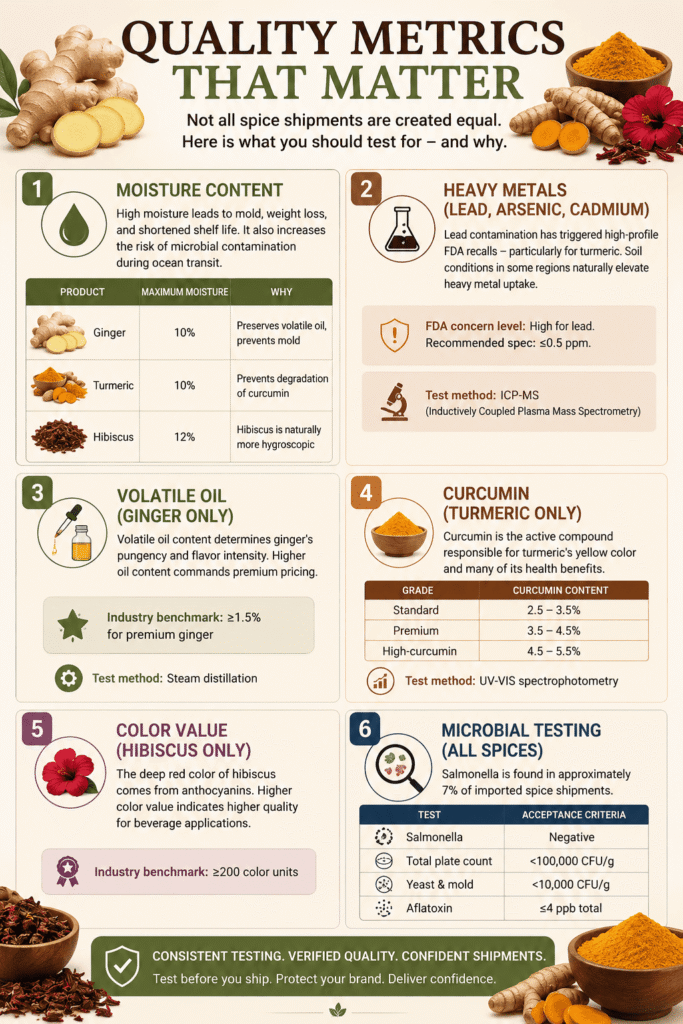
Not all spice shipments are created equal. Here is what you should test for, and why, as brought by the American Spice Trade Association (ASTA).
1. Moisture Content
High moisture leads to mold, weight loss, and shortened shelf life. It also increases the risk of microbial contamination during ocean transit.
|
Product |
Maximum Moisture |
Why |
|
Ginger |
10% |
Preserves volatile oil, prevents mold |
|
Turmeric |
10% |
Prevents degradation of curcumin |
|
Hibiscus |
12% |
Hibiscus is naturally more hygroscopic |
2. Heavy Metals (Lead, Arsenic, Cadmium)
Lead contamination has triggered high-profile FDA recalls particularly for turmeric. Soil conditions in some regions naturally elevate heavy metal uptake.
FDA concern level: High for lead. Recommended spec: ≤0.5 ppm.
Test method: ICP-MS (Inductively Coupled Plasma Mass Spectrometry)
3. Volatile Oil (Ginger Only)
Volatile oil content determines ginger’s pungency and flavor intensity. Higher oil content commands premium pricing.
Industry benchmark: ≥1.5% for premium ginger
Test method: Steam distillation
4. Curcumin (Turmeric Only)
Curcumin is the active compound responsible for turmeric’s yellow color and many of its health benefits.
|
Grade |
Curcumin Content |
|
Standard |
2.5 – 3.5% |
|
Premium |
3.5 – 4.5% |
|
High-curcumin |
4.5 – 5.5% |
Test method: UV-VIS spectrophotometry
5. Color Value (Hibiscus Only)
The deep red color of hibiscus comes from anthocyanins. Higher color value indicates higher quality for beverage applications.
Industry benchmark: ≥200 color units
6. Microbial Testing (All Spices)
Salmonella is found in approximately 7% of imported spice shipments.
|
Test |
Acceptance Criteria |
|
Salmonella |
Negative |
|
Total plate count |
<100,000 CFU/g |
|
Yeast & mold |
<10,000 CFU/g |
|
Aflatoxin |
≤4 ppb total |
FDA Compliance for Spice Importers
As the importer of record, you are legally responsible for ensuring your foreign supplier meets U.S. safety standards. Here is what you need to know.
FSVP (Foreign Supplier Verification Program)
Under 21 CFR Part 1 Subpart L, importers must verify that foreign suppliers produce food in compliance with FDA standards.
What you need from your supplier:
- Hazard analysis summary
- Supplier verification records (testing results, audit reports)
- Corrective action documentation
- Traceability records
How Jaaf Harvest helps: We provide all FSVP-ready documentation – hazard analysis, COAs, and written assurance for US importers.
Import Alert 99-19 (Salmonella)
This alert authorizes Detention Without Physical Examination (DWPE) for spices with a history of Salmonella contamination. Once a supplier is on this list, every shipment is detained and tested at the importer’s expense.
How to avoid it: Work with suppliers who provide negative Salmonella test results for every batch.
Import Alert 99-41 (FSVP)
Importers who cannot document FSVP compliance are placed on this alert. Shipments are detained until compliance is demonstrated.
How to avoid it: Maintain FSVP records for every foreign supplier.
Import Alert 99-42 (Heavy Metals)
This alert targets spices with excessive lead, arsenic, or cadmium. Turmeric is the most common offender.
How to avoid it: Require ICP-MS heavy metals testing on every shipment.
Prior Notice
All food shipments entering the United States require Prior Notice filed with the FDA at least 4 hours before arrival.
How Jaaf Harvest helps: We file Prior Notice for all DDP shipments. If you are importing FOB, we provide the information you need to file.
Export/Import Logistics Why DDP Shipping Stands Out
DDP stands for Delivered Duty Paid. It is an international shipping term (Incoterm) that places full responsibility on the seller.
With DDP, the supplier pays for:
- Export packaging
- Ocean freight
- Marine insurance
- US customs clearance
- US duties and taxes
- Final delivery to your door
You pay for:
- One invoice
No freight forwarders. No customs bonds. No unexpected bills.
For a detailed breakdown, download our free DDP Shipping Explainer (PDF)
DDP is not the only way to ship spices from Nigeria to the United States. Here are the most common alternatives – and why each one puts more risk and responsibility on you, the buyer.
EXW (Ex Works)
What it means: You pick up the goods directly from the supplier’s warehouse in Nigeria. You arrange everything including export packing, trucking to port, ocean freight, customs clearance, insurance, and final delivery.
Who bears risk: You (buyer) – 100%.
Best for: Experienced importers with established logistics partners in Nigeria. Not recommended for first-time buyers.
FOB (Free on Board)
What it means: The supplier delivers the goods to the named port of departure (usually Lagos or Tin Can Island Port) and loads them onto the vessel you nominate. You are responsible for ocean freight, insurance, customs clearance in the US, and final delivery.
Who bears risk: Shared. Supplier handles export. You handle everything from the vessel forward.
Best for: Buyers who have their own freight forwarder and want control over ocean freight pricing. Common in spice trade, but leaves you exposed to customs complexity.
CIF (Cost, Insurance, Freight)
What it means: The supplier arranges and pays for ocean freight and marine insurance to the named port of destination (e.g., Houston, Newark, Savannah). Your responsibility begins when the goods arrive at the US port. You still handle customs clearance, duties, and final delivery.
Who bears risk: Supplier handles transit. You handle US entry.
Best for: Buyers who want the supplier to manage ocean freight but are comfortable handling US customs. Still requires you to have a customs bond and file ISF.
Red Flags When Evaluating a Nigerian Spice Supplier
Here are five warning signs that should send you looking elsewhere.
Red Flag #1: “We don’t provide COAs” or “COAs cost extra”
Why it matters: You cannot verify quality without test results. A legitimate supplier tests every batch and provides documentation standard.
Red Flag #2: “We ship FOB only” (no DDP offered)
Why it matters: You bear all customs risk, documentation burden, and unexpected costs. DDP is not impossible – it is a choice. Choose a supplier who offers it.
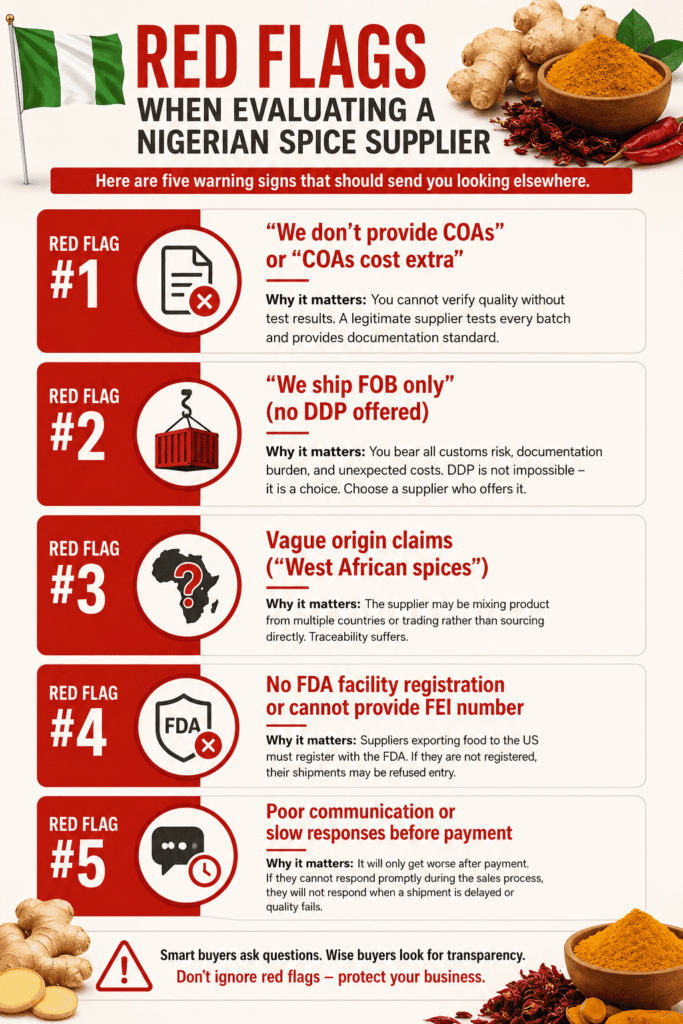
Red Flag #3: Vague origin claims (“West African spices”)
Why it matters: The supplier may be mixing product from multiple countries or trading rather than sourcing directly. Traceability suffers.
Red Flag #4: No FDA facility registration or cannot provide FEI number
Why it matters: Suppliers exporting food to the US must register with the FDA. If they are not registered, their shipments may be refused entry.
Red Flag #5: Poor communication or slow responses before payment
Why it matters: It will only get worse after payment. If they cannot respond promptly during the sales process, they will not respond when a shipment is delayed or quality fails.
How to Evaluate a Nigerian Spice Supplier (Checklist)
Use this checklist when interviewing potential suppliers. Download a printable version here.
Before you place your first order, ask every potential supplier these 10 questions:
- Do you provide a Certificate of Analysis (COA) for every batch?
- Do you test for heavy metals (lead, arsenic, cadmium)?
- Do you test for Salmonella and aflatoxin?
- What is your moisture specification for ginger, turmeric, and hibiscus?
- Do you offer DDP shipping (Delivered Duty Paid)?
- What is your minimum order quantity (MOQ)?
- Do you offer retail-ready packaging?
- Can you provide references from U.S. customers?
- Is your facility registered with the FDA? (What is your FEI number?)
- What happens if quality fails to meet specifications?
Score your supplier:
- 10/10 yes: Proceed with confidence
- 7-9/10 yes: Good, but verify missing items
- 4-6/10 yes: High risk – get missing answers in writing
- 0-3/10 yes: Do not buy
Getting Started with Jaaf Harvest
We built Jaaf Harvest to be the supplier we wished existed when we were on the buyer’s side of the table.
For manufacturers and bulk importers
|
Offering |
Details |
|
Sample program |
500g samples of ginger, turmeric, or hibiscus – $25 (refundable on first order) |
|
Starter pack |
10kg or 200kg – perfect for production trials |
|
Bulk orders |
20kg or 40kg sacks to full container loads |
|
Lead time |
Samples: 5-7 days. Commercial orders: 25 -4 5 days. |
|
Shipping |
FOB, CIF, Ex-Works (DDP Possible) |
For retailers and resellers (Small – Medium importers)
|
Offering |
Details |
|
Wholesale account |
10kg mixed case minimum (10% off on first order) |
|
Retail-ready packaging |
Stand-up pouches with FDA labels |
|
Shipping |
7-10 day delivery to most US addresses |
|
DDP shipping Available |
Standard – one price, delivered to your door |
Ready to Source with Confidence?
Take the next step
📄 Download the Nigerian Spice Sourcing Checklist – 10 questions to ask every supplier (free PDF)
📦 Request a Sample (refundable on first order)
🏪 Open a Wholesale Account to get 10% off – For Small – Medium Orders
📘 Download the DDP Shipping Explainer – Full guide to hassle-free importing
FAQ: Sourcing Nigerian Spices for the US Market
1. Is Nigerian spice quality comparable to Indian or Chinese spices?
Yes – and for certain applications, Nigerian spices are superior. Nigerian ginger is known for higher volatile oil content (more pungent). Nigerian hibiscus is significantly more affordable than Indian or Egyptian sources. Nigerian turmeric offers comparable curcumin levels at a lower price point.
2. How long does shipping take from Nigeria to the US?
This depends on order type.
Bulk order (Sea Freight): Total timeline from order to delivery: 30-45 days.
- Order processing and packaging: 5-7 days
- Ocean freight to US port: 20-25 days
- Customs clearance and final delivery: 5-7 days
Small – Medium order (Air Freight): Total timeline from order to delivery: 5-10 days.
- Order processing and packaging: 1-2 days
- Air freight to US: 1-2 days
- Customs clearance and final delivery: 2-3 days
3. What is DDP shipping and why should I care?
DDP (Delivered Duty Paid) means the supplier handles all costs and customs clearance. You pay one price. The product arrives at your door. No freight forwarders. No customs bonds. No unexpected duties. [Download our full DDP explainer below.]
4. Do you provide Certificates of Analysis (COAs)?
Yes – for every batch. Every shipment includes a COA showing moisture, heavy metals (lead, arsenic, cadmium), microbial results (Salmonella, TPC, yeast/mold), and product-specific tests (volatile oil for ginger, curcumin for turmeric, color value for hibiscus).
5. What is your minimum order quantity (MOQ)?
- Manufacturers: 10kg starter pack (ginger, turmeric, or hibiscus)
- Retailers: 10kg mixed case (any combination of products and sizes)
- Bulk orders: 20k or 40kg sacks or full container loads
6. Are your spices organic?
Not yet certified – but we are in the documentation phase for USDA Organic certification for ginger, turmeric, and hibiscus. Pre-certification supply is available. Contact us for growing practice documentation.
7. How do I know if a Nigerian spice supplier is legitimate?
Use our 10-question checklist above. Red flags include: no COAs, no DDP, vague origin claims, no FDA registration, and poor communication. Download the printable checklist here.
8. What happens if my shipment fails FDA inspection?
With DDP shipping, the supplier manages customs clearance – including any exams or detentions. You are not billed for exam fees or storage. Without DDP, the importer bears all risk. We strongly recommend DDP for first-time buyers.
9. Can you ship samples before I place a bulk order?
Yes. Request a 500g sample of ginger, turmeric, or hibiscus for $25. The $25 is refunded on your first commercial order.
10. Do you only sell to manufacturers, or also to small shops?
Both. We work with:
- Manufacturers (10kg+ orders, bulk packaging)
- Retail shop owners (10kg units mixed case, retail-ready packaging)
- Resellers (wholesale accounts with no annual commitment)